
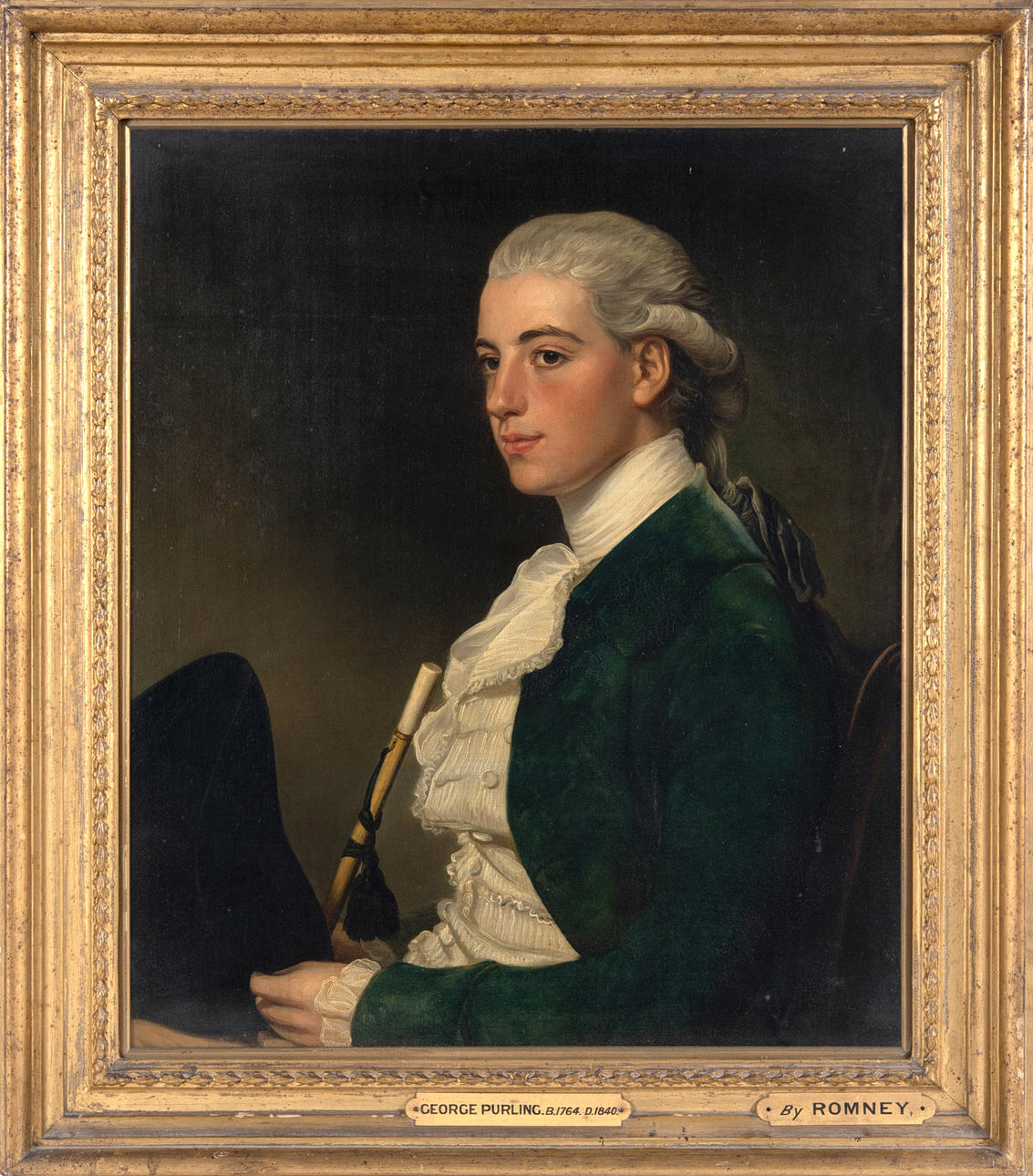
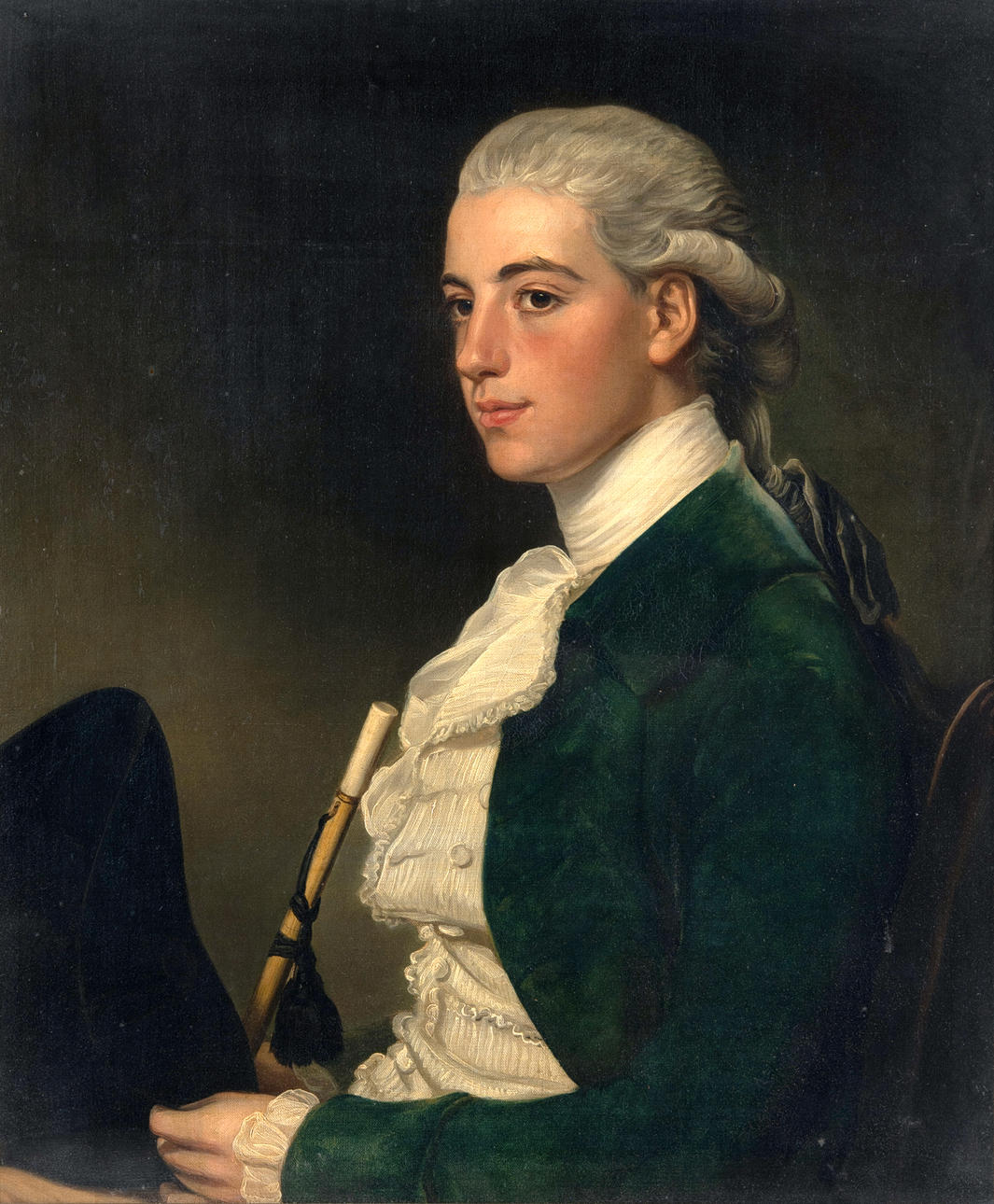
350. ATTRIBUTED TO GEORGE ROMNEY (1734-1802). PORTRAIT OF A YOUNG GENTLEMAN, GEORGE PURLING (1764/5-1840).
This auction is closed, but maybe you like the following items?
Images
Description
Seated half length, wearing a blue-green coat, cream ruched waistcoat, white neckcloth and stock, his hair en queue, holding a cane (or whip) and a dark hat, oil on canvas, original gilt frame
72.5 x 60.5cm.
Provenance: By descent in the Purling family, probably to the sitter's brother Charles's (1748-1791) daughter, Emilia Anne (1782-1859). Emilia Anne married Hastings Nathaniel Middleton (1782-1821) in 1804; thence by direct descent.
Exhibited: London, Grafton Galleries, 1900
Literature: T. H. Ward and William Roberts, `Romney: A Biographical and Critical Essay with a Catalogue Raisonné of his Works`, 1904
This portrait of a fashionable young man holding his cane and tricorne has recently become the subject of controversy. The sitter has always been understood to be George Purling (c. 1765-1840), the third son of Matthew and Frances Purling of the island of St Helena, and the male half of a brother-and-sister double commission given to George Romney in 1778, when the artist had just ascended to the height of fashion as a society portraitist in London. Both portraits were owned by George Purling in later life, were bequeathed by him to his great-nephew, and then passed in the family by direct descent until they were consigned for sale in 2023. Both were shown as by Romney in the celebrated Grafton Galleries exhibition of his work in 1900, and both were catalogued in T. H. Ward and William Roberts's catalogue raisonné of Romney's paintings published in 1904.
Until recently the only public evidence for the paintings' appearance consisted of two faded monochrome photographs taken at the 1900 exhibition and preserved in the files of the Heinz archive at the National Portrait Gallery. Murky as the photograph of George's portrait was, enough was visible to sow doubt about the attribution to Romney in the mind of the present writer in the run up to the publication of his new catalogue in 2015. On the view that the two portraits had been painted at the same time, could this young man really be as young as thirteen or fourteen years old, even allowing for the fact that Romney tended to make his sitters look older than they really were? More disturbingly, there appeared something uncharacteristic in the handling of parts of the figure: the heavy features and carefully delineated hair; even the fabric of the white waistcoat. Alongside these visual considerations was the lack of documentary evidence for the portrait. Whereas Romney's studio papers recorded sittings and a payment for Miss Purling's portrait, these were lacking for the portrait of George (with the exception of one visit from 'Mr Purling', which seems more likely to have been an inspection from a Mr. Purling senior than a solitary sitting for a finished portrait of Mr Purling junior). It is true that Romney's book-keeping was not always impeccable, and it is not difficult to think up scenarios whereby the portrait of George slipped through the cracks. (In particular, Romney had the annoying habit of recording payments in the first sketchbook to hand, not in his official account-book.) But taken in conjunction with the other doubts, one conclusion was crying out: George's portrait actually wasn't by George Romney after all. Couldn't this be a case of that common late 18th-century phenomenon with double-commissions: the male sat to one artist, the female to another?
So matters rested until the opportunity arose in 2022 to examine the two portraits in the flesh. It now became clear that, whatever else had happened to the portrait, Romney had worked on it: perhaps less clearly on the figure than on the subordinate areas of the canvas which had remained invisible in the old photograph. In such circumstances, phenomena such as joint authorship, overpainting, or selective cleaning, tend to be invoked; but here the report written for private consumption in the wake of the examination avoided discussing such possibilities in favour of emphasising that Romney's hand was visible after all, and thus that family tradition remained unsullied. This has led to a situation where conflicting views of the portrait's 'authenticity' or otherwise have obtained free rein.
In the light of current knowledge, it is not possible to state with any certainty what the early history of the portrait was. A few provisional statements may however be worth making. Firstly, the evidence seems to support a theory of the portrait's prolonged and complex gestation – probably involving more than one hand, and further complicated by the fact that George Purling spent most of the years between 1780 and 1800 in India. Secondly, it seems valid to question whether the sitter is as young as thirteen or fourteen here, and to propose that if the painting genuinely was undertaken in 1778 at the time the pendant was, he has been made to look considerably older. It has recently been claimed that in 1791 George inherited from an uncle an ivory and whalebone walking stick; could this be the cane in the portrait, adapted to include it? Thirdly, Romney's handiwork on the picture can only be explained, in the absence of a realistic number of sittings and any known payments, either in terms of his fee being waived, his work having consisted in rapidly pulling together the beginning made by another portraitist to whom the actual capturing of a likeness had been delegated; or else because he was being paid in kind, or for some other comparable reason. Yet when all this has been said, there are still dozens of imaginable scenarios. Whatever future research brings to light, this need not mask the actuality of a portrait that is elegance personified and all the more fascinating for the secrets it retains.
We are very grateful to Alex Kidson for writing this footnote and for his help with cataloguing this picture.
Condition
Old lining; light scattered retouching over some craquelure and/or other minor surface blemishes.
Resale right
Sale
Do you have something similar to sell? Get your items valued free of charge!
Bidding
Have your item valued free of charge.
Description
Seated half length, wearing a blue-green coat, cream ruched waistcoat, white neckcloth and stock, his hair en queue, holding a cane (or whip) and a dark hat, oil on canvas, original gilt frame
72.5 x 60.5cm.
Provenance: By descent in the Purling family, probably to the sitter's brother Charles's (1748-1791) daughter, Emilia Anne (1782-1859). Emilia Anne married Hastings Nathaniel Middleton (1782-1821) in 1804; thence by direct descent.
Exhibited: London, Grafton Galleries, 1900
Literature: T. H. Ward and William Roberts, `Romney: A Biographical and Critical Essay with a Catalogue Raisonné of his Works`, 1904
This portrait of a fashionable young man holding his cane and tricorne has recently become the subject of controversy. The sitter has always been understood to be George Purling (c. 1765-1840), the third son of Matthew and Frances Purling of the island of St Helena, and the male half of a brother-and-sister double commission given to George Romney in 1778, when the artist had just ascended to the height of fashion as a society portraitist in London. Both portraits were owned by George Purling in later life, were bequeathed by him to his great-nephew, and then passed in the family by direct descent until they were consigned for sale in 2023. Both were shown as by Romney in the celebrated Grafton Galleries exhibition of his work in 1900, and both were catalogued in T. H. Ward and William Roberts's catalogue raisonné of Romney's paintings published in 1904.
Until recently the only public evidence for the paintings' appearance consisted of two faded monochrome photographs taken at the 1900 exhibition and preserved in the files of the Heinz archive at the National Portrait Gallery. Murky as the photograph of George's portrait was, enough was visible to sow doubt about the attribution to Romney in the mind of the present writer in the run up to the publication of his new catalogue in 2015. On the view that the two portraits had been painted at the same time, could this young man really be as young as thirteen or fourteen years old, even allowing for the fact that Romney tended to make his sitters look older than they really were? More disturbingly, there appeared something uncharacteristic in the handling of parts of the figure: the heavy features and carefully delineated hair; even the fabric of the white waistcoat. Alongside these visual considerations was the lack of documentary evidence for the portrait. Whereas Romney's studio papers recorded sittings and a payment for Miss Purling's portrait, these were lacking for the portrait of George (with the exception of one visit from 'Mr Purling', which seems more likely to have been an inspection from a Mr. Purling senior than a solitary sitting for a finished portrait of Mr Purling junior). It is true that Romney's book-keeping was not always impeccable, and it is not difficult to think up scenarios whereby the portrait of George slipped through the cracks. (In particular, Romney had the annoying habit of recording payments in the first sketchbook to hand, not in his official account-book.) But taken in conjunction with the other doubts, one conclusion was crying out: George's portrait actually wasn't by George Romney after all. Couldn't this be a case of that common late 18th-century phenomenon with double-commissions: the male sat to one artist, the female to another?
So matters rested until the opportunity arose in 2022 to examine the two portraits in the flesh. It now became clear that, whatever else had happened to the portrait, Romney had worked on it: perhaps less clearly on the figure than on the subordinate areas of the canvas which had remained invisible in the old photograph. In such circumstances, phenomena such as joint authorship, overpainting, or selective cleaning, tend to be invoked; but here the report written for private consumption in the wake of the examination avoided discussing such possibilities in favour of emphasising that Romney's hand was visible after all, and thus that family tradition remained unsullied. This has led to a situation where conflicting views of the portrait's 'authenticity' or otherwise have obtained free rein.
In the light of current knowledge, it is not possible to state with any certainty what the early history of the portrait was. A few provisional statements may however be worth making. Firstly, the evidence seems to support a theory of the portrait's prolonged and complex gestation – probably involving more than one hand, and further complicated by the fact that George Purling spent most of the years between 1780 and 1800 in India. Secondly, it seems valid to question whether the sitter is as young as thirteen or fourteen here, and to propose that if the painting genuinely was undertaken in 1778 at the time the pendant was, he has been made to look considerably older. It has recently been claimed that in 1791 George inherited from an uncle an ivory and whalebone walking stick; could this be the cane in the portrait, adapted to include it? Thirdly, Romney's handiwork on the picture can only be explained, in the absence of a realistic number of sittings and any known payments, either in terms of his fee being waived, his work having consisted in rapidly pulling together the beginning made by another portraitist to whom the actual capturing of a likeness had been delegated; or else because he was being paid in kind, or for some other comparable reason. Yet when all this has been said, there are still dozens of imaginable scenarios. Whatever future research brings to light, this need not mask the actuality of a portrait that is elegance personified and all the more fascinating for the secrets it retains.
We are very grateful to Alex Kidson for writing this footnote and for his help with cataloguing this picture.
Condition
Old lining; light scattered retouching over some craquelure and/or other minor surface blemishes.
Resale right
Sale
Do you have something similar to sell? Get your items valued free of charge!
Details
- Catalogue no
- 350

Winter Fine Art Auction 2024
Welcome to our Winter Fine Art Auction to be sold across four days of auctions.
Tuesday 16th January - 10am
SILVER & VERTU
Wednesday 17th January - 10am
PICTURES, COLLECTORS, 19TH/20TH CENTURY DESIGN & CERAMICS
Thursday 18th January - 10am
JEWELLERY & WATCHES
Friday 19th January - 10am
FURNITURE, CLOCKS & RUGS
Viewing Times:
Saturday 13th January - 09:30 - 12:30
Monday 15th January - 09:30 - 16:30
Tuesday 16th January - 09:30 - 16:30
Wednesday 17th January - 09:30 - 16:30
Thursday 18th January - 09:30 - 16:30